Table of contents
- The short version
- What it really costs, and why the answer is usually a shrug
- How much does it cost to build an app in 2026
- App development cost by complexity
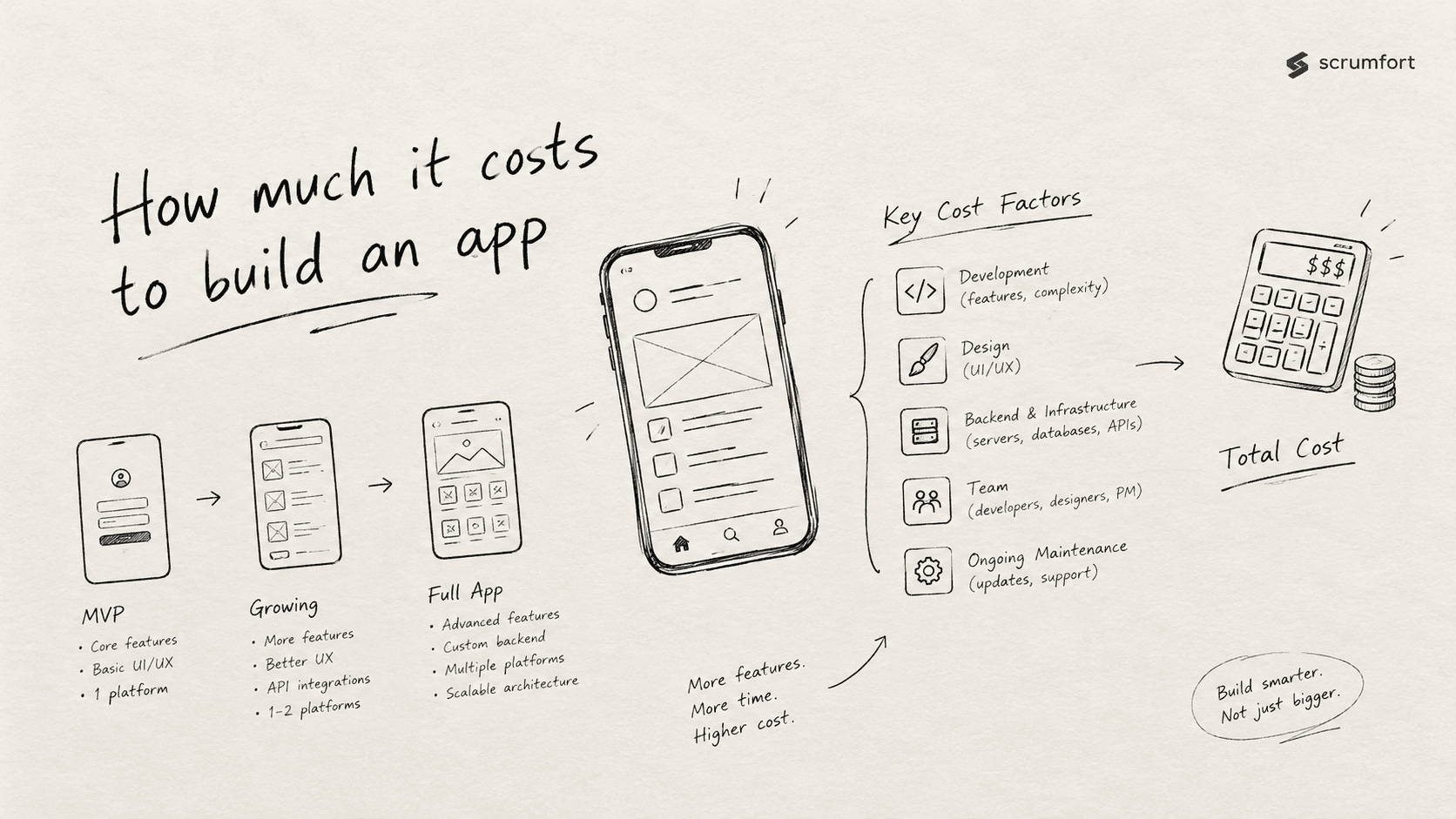
- What actually drives the cost to build an app
- One platform or two, and native versus cross-platform
- People also ask about app cost
- How much does it cost to build an app like Uber or Instagram
- Is a cross-platform app really cheaper
- What is the cheapest honest way to build an app
- How much does it cost to maintain an app
- Why a fixed number beats a lower one
- Frequently asked questions
- How much does it cost to build an app on average
- What makes one app cost far more than another
- How long does it take to build an app
- Do we own the app and its code
- Related reading
The short version
- Across the market, building an app in 2026 costs anywhere from about $15,000 for a simple one to $500,000 or more for a complex or regulated product. Most sources put a typical custom app somewhere in the tens of thousands to low hundreds of thousands.
- That range is so wide because almost nobody publishes a real number, and because the biggest single factor is the team you hire, not the idea. We at Scrumfort publish it. A mobile app starts at $12,000 for one platform and $15,000 for both stores, with most projects landing between $15,000 and $35,000, on a fixed price.
- What actually moves the figure is the number of features, whether you build for one platform or both, whether the backend already exists, and how much compliance the app carries.
What it really costs, and why the answer is usually a shrug
How much does it cost to build an app in 2026
Search how much does it cost to build an app and every result gives you the same non-answer: somewhere between five figures and half a million dollars, followed by a contact form. It is not that these guides are wrong, app development cost genuinely does swing that much, but they leave a founder no closer to a budget. This guide gives you the honest market ranges, explains what actually drives the cost to build a mobile app, and then does the thing most of these pages will not, which is name a fixed number you can plan around rather than a range you cannot.
The short answer
In 2026, the cost to build an app ranges from roughly $15,000 for a simple single-platform app to $500,000 or more for a complex or regulated one, driven mostly by feature count, platform, backend, compliance, and the structure of the team you hire. At Scrumfort a mobile app starts at $12,000 for one platform connecting to an existing backend and $15,000 for both app stores, with most projects landing between $15,000 and $35,000, all on a fixed price against a fixed scope.
App development cost by complexity
The most useful way to place your own app is by how much it has to do. The table below gives the common 2026 market bands by complexity, so you can find the row that sounds like your product instead of staring at one enormous range.
| Tier | What it usually includes | Typical market cost | Timeline |
|---|---|---|---|
| Simple app | One platform, a few screens, sign-in, basic features | $15,000 to $60,000 | 1 to 4 months |
| Medium app | Payments, user accounts, an admin panel, integrations | $60,000 to $180,000 | 4 to 9 months |
| Complex app | Multiple roles, AI features, heavy integrations, scale | $180,000 to $500,000+ | 9 to 18 months |
| Fintech or regulated | The above plus heavy security and compliance | $200,000 to $400,000+ | 6 to 14 months |
Two honest notes on that table. Those bands assume a range of team structures, and every serious source agrees the single biggest swing factor in the whole equation is the team you hire and how it is set up, not the app itself. And the word most matters. Most first apps do not need to be complex, and founders routinely pay for a medium or complex build when a simple one would have proven the idea.
What actually drives the cost to build an app
Five things move an app quote more than anything else, and understanding them is how you keep the number sane without gutting the product.
Feature count. The biggest lever by a distance. Every feature is design, build, and testing, so the jump from three features to eight is not linear, it compounds. A real first version cuts to the one or two features that prove the idea.
Platform. One platform costs less than two, and two separate native apps cost more than one cross-platform build that covers both. For most business apps, a single cross-platform codebase serving iOS and Android is the sensible cost choice, which is the whole reason it exists.
Backend. Connecting to a backend you already run is cheaper than building a new one. If the app needs its own server, accounts, and data, that is real engineering that belongs in the budget from the start rather than as a surprise.
Compliance and integrations. Payments, third-party APIs, and anything regulated each add engineering and often their own fees. Health and finance apps sit at the top of the ranges for exactly this reason.
The team and how you engage it. The same app can carry wildly different price tags depending on who builds it and how the engagement is priced. An open hourly contract that drifts is the most expensive shape of all, because the meter is not yours to control.
One platform or two, and native versus cross-platform
This choice moves the cost to build a mobile app as much as any feature. Building two separate native apps, one for iOS and one for Android, is the most expensive route, because you are effectively paying for two apps and every future change twice. A single cross-platform build with Flutter or React Native covers both stores from one codebase, and that saving compounds over the life of the product because updates ship once to both platforms. Native still earns its cost when you need heavy graphics performance or deep hardware integration, but for the large majority of business apps, cross-platform is the cost-sensible default. If you want the full trade-off, our guide to React Native versus Flutter covers it.
People also ask about app cost
How much does it cost to build an app like Uber or Instagram
A great deal, because those are complex apps at scale. A product with the feature depth of Uber or Instagram sits at the top of the market, commonly $200,000 to $500,000 or more, and years of ongoing work. The useful takeaway is not the headline number, it is that you do not build the finished version first. You build the one core loop that proves the idea, then grow.
Is a cross-platform app really cheaper
Yes, for most apps. One codebase for both stores costs less to build than two native apps and far less to maintain, since every change is made once. The exceptions are apps that lean hard on platform-specific performance or hardware, which are a minority.
What is the cheapest honest way to build an app
Cut scope to a single core feature, build cross-platform, connect to a backend rather than building one where you can, and insist on a fixed, written scope so the price cannot drift. The cheapest app is not the lowest quote, it is the one that tests your idea for the least money and does not have to be rebuilt.
How much does it cost to maintain an app
Across the market, budget roughly 15 to 25 percent of the build cost per year. Apps need maintenance even if you change nothing, because Apple and Google ship OS updates and change store rules, and an app left untouched for two years usually breaks. We include thirty days after launch, then from $900 a month.
Why a fixed number beats a lower one
When you are budgeting an app, predictability is worth more than a rock-bottom rate. A low hourly quote that drifts 40 percent over is worse for a founder than a slightly higher fixed price that holds, because you cannot plan a launch, a raise, or a runway against a number that keeps moving. That is why the enormous range every guide quotes is not just unhelpful, it is a risk. A fixed price on a settled scope moves that risk off your plate and answers the two questions that matter alongside cost: how long it will take, and whether you own what you paid for.
By the numbers
- Market range roughly $15,000 to $500,000+, driven mostly by scope and the team you hire
- Our mobile apps from $12,000 for one platform and $15,000 for both stores, fixed
- Most of our app projects land between $15,000 and $35,000
- 30 days of support included, then from $900 a month, because apps need ongoing maintenance
© 2026 Scrumfort. All rights reserved.
The honest answer to what an app costs is not a smaller range, it is a fixed number against a scope you have seen. That is how we approach mobile app development, so the price you plan around is the price you pay.
Frequently asked questions
How much does it cost to build an app on average
The 2026 market runs from about $15,000 for a simple app to $500,000 or more for a complex one, with most custom apps in the tens to low hundreds of thousands. Our mobile apps start at $12,000 for one platform and $15,000 for both stores, with most between $15,000 and $35,000 on a fixed price.
What makes one app cost far more than another
Feature count above all, then platform, whether the backend exists, compliance, and the team and pricing model. Two founders describing the same idea can get quotes a factor apart purely from how many features each scoped and how the work is priced.
How long does it take to build an app
A simple app is often one to four months, a complex one much longer. We ship most apps in ten to fourteen weeks, plus one to two for store review, on a fixed timeline set after discovery.
Do we own the app and its code
With us, completely, in your own repository, and the app is published under your own Apple and Google accounts, so the listings, reviews, and store relationship are yours. Ownership matters more for an app than almost anything, because it is the asset you are funding.
Related reading
- Mobile app development for how we scope, price, and ship cross-platform apps, with the fixed price.
- MVP development cost if you want to test the idea with a leaner first build.
- React Native vs Flutter for the cross-platform choice that shapes the budget.
Want your exact number instead of a range? See how we price mobile app development, on a fixed price from $12,000.
If you take one thing from this, let it be that the cost of an app is a scope decision, not a mystery. Decide the one thing you need to prove, cut to it, build cross-platform, and get the number in writing. When you want that number for your own idea, see how we handle mobile app development or tell us what you are building and we will map it with you.